
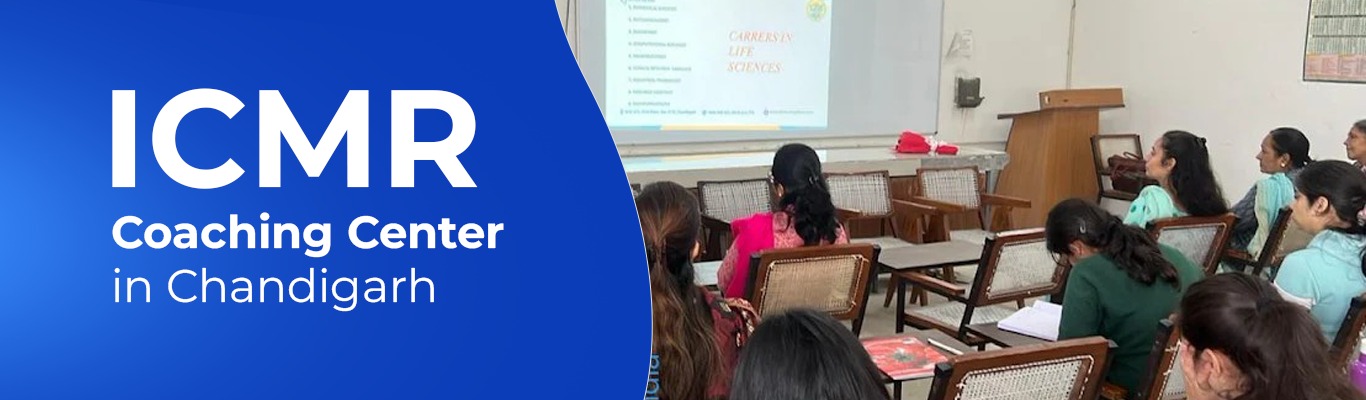

Biotech Sapiens — Chandigarh’s Most Trusted Destination for ICMR-JRF | DHR – BRET Preparation.
Are you aiming to build a career in biomedical research? The ICMR-JRF | DHR – Biomedical Research Eligibility Test (BRET) is your gateway to one of India’s most prestigious research fellowship programmes — and Biotech Sapiens is here to make sure you walk in prepared and walk out successfully.
What is the ICMR-JRF | DHR – BRET?
The Department of Health Research (DHR), in collaboration with the Indian Council of Medical Research (ICMR), conducts the Biomedical Research Eligibility Test (BRET) — a national-level Computer-Based Test (CBT) held annually, typically in the first or second week of July. Qualifying BRET actually makes you eligible for the Junior Research Fellowship (JRF), which supports your Ph.D. journey at any UGC-recognised university or ICMR institute across India.
A tentative total of 250 candidates is selected each year, subject to budgetary provisions and DHR guidelines. The result remains valid for one year from the date of the award letter.
The ICMR-JRF | DHR-BRET examination is conducted through designated Computer-Based Test (CBT) centres across multiple states and major cities in India. Candidates can select their preferred examination city during the application process, subject to availability and official notification guidelines.
ICMR-JRF | BRET Fellowship Amount 2026
Selected candidates receive the following stipend:
| Fellowship Stage | Monthly Stipend |
| JRF (Year 1 & Year 2) | Rs. 37,000/- per month |
| SRF (Year 3 onwards, upon upgrade) | Rs. 42,000/- per month |
An annual contingency grant of Rs. 20,000/- is also provided to support research activities. HRA is applicable as per government rules.
Additionally, the top 10% performers in the merit list are honoured with the ‘Exemplary Performance Reward’ — a special research contingency of Rs. 1,00,000/- per annum for the JRF tenure, along with eligibility for a one-time DHR International Travel Grant.
The total duration of the fellowship is 5 years — JRF for the first two years, upgradeable to SRF after 22 months upon successful assessment by a Review Committee.
Eligibility Criteria for ICMR-JRF | BRET 2026
Age Limit
Candidates must be 28 years of age or below at the time of applying. Age relaxation is offered as follows:
- SC/ST, Physically Handicapped (PH) & Female candidates — up to 5 years
- OBC candidates — up to 3 years
Educational Qualification
Candidates must hold an M.Sc. or equivalent postgraduate degree (M.Tech / M.Pharm / M.V.Sc. or equivalent) in relevant biomedical, life science, behavioural, or public health disciplines such as:
Life Sciences, Zoology, Botany, Biomedical Sciences, Microbiology, Biochemistry, Genetics, Biotechnology, Biophysics, Bioinformatics, Forensic Sciences, Environmental Sciences, Food & Nutrition, Molecular Biology, Ecology, Immunology, Neurosciences, Veterinary Sciences, Nursing, Biostatistics, Pharmacology, Pharmaceutical Sciences, Public Health, Psychology, Sociology, Anthropology & related subjects.
- General / EWS / OBC candidates — minimum 55% aggregate marks in postgraduate qualification
- SC / ST / PwBD candidates — minimum 50% aggregate marks in postgraduate qualification
ICMR-JRF | DHR – BRET 2026: Updated Exam Pattern & Syllabus
The BRET is a computer-based test (CBT) consisting of 150 objective-type multiple-choice questions to be completed in 3 hours (180 minutes). Candidates can navigate freely across all sections during the exam.
The paper is structured into 3 Sections — each carrying approximately 50 questions — as follows:
Section A — Aptitude & Analytical Skills
50 Questions | Compulsory
- Reading comprehension of scientific and analytical passages
- Verbal and non-verbal reasoning
- Data interpretation and deductive reasoning
- Logical reasoning and data analysis
- Numerical analysis and graphical interpretation
- Quantitative comparison and problem-solving
Section B — General & Interdisciplinary Knowledge
50 Questions | Compulsory
- Molecular basis of cellular changes
- Cell structure and intercellular communication
- Fundamentals of basic physiology
- Principles of genetics & genomics
- Evolution and the origin of life
- Biotechnology processes and their real-world applications
- Biosafety regulations & bioethical frameworks
- Immunology — innate and adaptive immune responses
- Common infections caused by bacteria, viruses, fungi & parasites
Qualifying Marks (BRET 2026)
| Category | Minimum Qualifying Score |
| General / OBC / EWS / PwBD | 50% aggregate across all sections |
| SC / ST | 45% aggregate across all sections |
Ph.D. Enrolment After Selection
- The first 60% of selected candidates can enrol for a Ph.D. in biomedical/health research at any UGC-recognised university or Institute of National Importance.
- The remaining 40% will mandatorily enrol at one of the 27 ICMR institutes/centres, registered under the ICMR-Faculty of Medical Research (AcSIR).
Section C — Domain-Specific Knowledge
50 Questions | Choose ONE discipline at the time of application
| Domain | Areas Covered |
| A. Microbiology | Bacteriology, Virology, Parasitology, Entomology, Mycology |
| B. Biochemistry | Core biochemical concepts and pathways |
| C. Biostatistics | Statistical methods for biomedical research |
| D. Veterinary Science / Medicine | Animal health, veterinary medical sciences |
| E. Public Health | Epidemiology, community health, health policy |
| F. Nursing | Clinical and health sciences |
| G. Biotechnology | Bioprocesses, techniques, and applications |
| H. Social & Behavioural Sciences | Anthropology, Sociology, Psychology |
| I. Nutrition | Nutritional biochemistry, food science, dietetics |
| J. Pharmacology | Drug mechanisms, pharmacokinetics, therapeutics |
| K. Biological Science | Life Science, Human Biology, Environmental Sciences, Zoology, Botany |
Prepare for ICMR-JRF | BRET 2026 with Biotech Sapiens, Chandigarh
At Biotech Sapiens, our ICMR coaching programme is built around the latest CBT-based BRET exam pattern & the updated 2026 syllabus. Whether you are targeting a top merit rank or aiming for the Exemplary Performance Reward, our structured approach basically gives you the competitive advantage you need.
Here is what sets Biotech Sapiens apart:
- Expert Faculty with Research & Exam Expertise — Learn from mentors who stay updated with every ICMR notification & pattern change
- Fully Revised Study Material for BRET 2026 — Covering all three sections: Aptitude, General Knowledge, and Domain-Specific subjects
- Offline & Online Coaching Flexibility — Attend classes in Chandigarh or learn remotely — the choice is yours
- CBT-Focused Mock Tests — Practice in a simulated computer-based environment to build real exam confidence
- Regular Doubt-Clearing Sessions — Every concept is clarified before you move forward
- Performance Tracking & Analytics — Regular assessments to monitor your progress and sharpen your weak areas
- Small Batch Sizes — Personalised attention so no student gets left behind
- Affordable & Transparent Fees — Premium coaching at a price that makes sense
Don’t wait for the next cycle to go by! Join Biotech Sapiens and learn from the experts. Your Research Career Starts Here.